
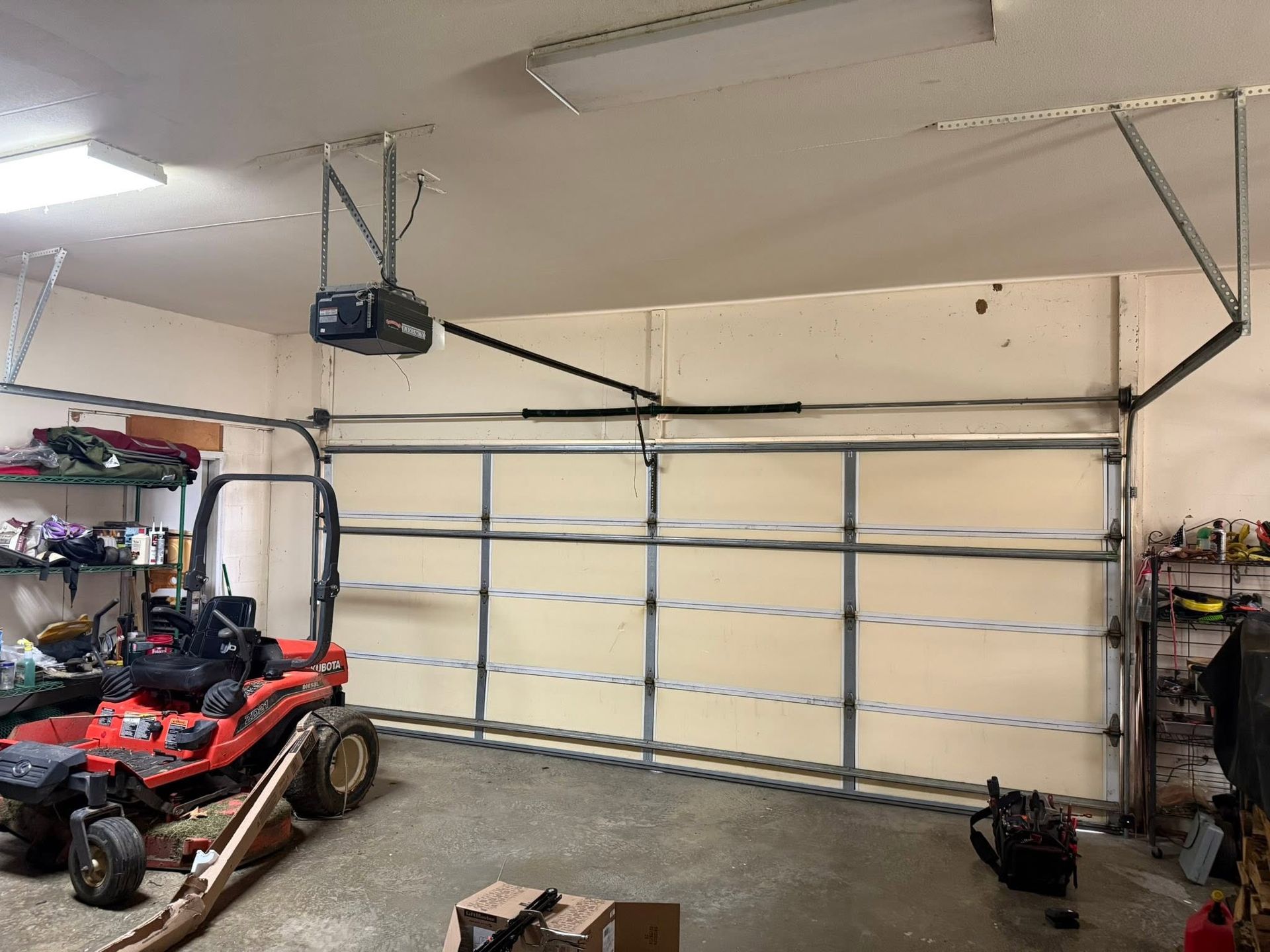
Opener Installation Starts With the Door, Not the Hardware
Garage Door Opener Installation in Benton for homes without existing opener provisions or with hardware that needs replacement
Mounting a garage door opener to a door that isn't ready for one produces a system that strains, cycles unevenly, and fails prematurely—sometimes within months of installation. Many older homes in Haskell and Alexander were built before integrated opener provisions were standard, which means the header space, door balance, and track geometry each need to be confirmed before any hardware goes up. Fowler Overhead Doors, LLC approaches opener installation by assessing the door first, correcting any balance or clearance issues, and then mounting the opener to a system that's prepared to run it correctly.
The installation sequence begins with a manual balance check: the technician disconnects any existing mechanism and lifts the door by hand to confirm it holds at mid-travel without assistance. A door that drops or rises on its own has a spring tension issue that will shorten the opener motor's service life if left uncorrected before installation. Once the door is confirmed balanced and the header clearance is sufficient for the rail, the technician fits the rail, mounting bracket, and header support, sets the travel and force limits, and installs the photo-eye safety sensors at the correct height for the door opening. The wall control and remotes are programmed, and the auto-reverse function is tested with an obstruction in the door's path before the job is complete.
Request a site evaluation to confirm your door's readiness and header clearance before selecting an opener model.
What Opener Installation Actually Accomplishes
An opener installation is complete only when the entire system—door, springs, tracks, and drive unit—operates as a coordinated assembly. The force and travel limit settings are calibrated to the specific door's weight and stroke length, not set to a default value, because a limit that's too high will push the door into the closed stop with enough force to damage the bottom seal and frame over time. The photo-eye sensors are positioned at a height that detects an obstruction a vehicle or person would present, and their alignment is verified so the door won't refuse to close because of a sensor that's slightly off-axis.
Once installation is finished, the door opens and closes from the wall control and any programmed remotes without requiring manual correction or a second button press. The auto-reverse test produces a clean reversal before contact when an obstruction is placed in the path. Fowler Overhead Doors confirms all functions before leaving, so the system is fully operational rather than requiring follow-up adjustments.
Because Fowler Overhead Doors is owner-operated and handles opener repairs as ongoing work, the crew that installs the unit is the same one available if the opener requires service later. That means the installation settings and any door-specific adjustments are known to the technician who would respond to a repair call, rather than being unknown to a different crew starting from scratch.
Questions Before Starting Your Project
These questions address the preparation, sequencing, and functional specifics that come up most often when homeowners in Benton are planning an opener installation on an existing door.
Why does door balance need to be confirmed before the opener is mounted?
An opener motor is sized to assist a balanced door, not to lift an unbalanced one. A door with incorrect spring tension forces the motor to compensate on every cycle, which accelerates wear on the drive mechanism and can trigger the motor's thermal overload protection during repeated use.
How is header clearance determined for homes without existing opener provisions?
The technician measures from the top of the door opening to the ceiling and checks for obstructions along the full rail path. Standard rail assemblies require a minimum clearance above the door's high point in travel; low-clearance brackets and shorter rail configurations are available for situations where ceiling height is restricted, which is a consideration in some older homes in Benton and Alexander built with lower garage ceiling heights.
What is the photo-eye sensor height requirement and how is it set?
Photo-eye sensors are mounted at a height that places the beam in the path of a person or vehicle at ground level, typically within a few inches of the floor. The exact height is set based on the door's bottom clearance and the specific sensor model, and the beam alignment is tested with a solid object before the installation is considered complete.
How are travel and force limits set for a specific door?
The technician runs the door through a series of test cycles and adjusts the limit settings until the door stops cleanly at both the open and closed positions without coasting past or reversing unnecessarily. Force settings are calibrated so the door reverses on contact with an obstruction but doesn't reverse from normal friction during cold operation.
What happens if a door in an older Benton home has a non-standard section height that affects the rail geometry?
Sectional doors in homes built in earlier decades occasionally have section heights that don't correspond to current standard dimensions, which affects where the rail must be positioned relative to the top section. The technician accounts for this during the header bracket placement so the rail angle produces smooth transition from vertical to horizontal travel rather than a bind at the curve.
Fowler Overhead Doors, LLC installs garage door openers on residential and commercial doors, with the same owner-operated crew available for follow-up repairs after installation. Fowler Overhead Doors also installs garage door openers in Bryant, Alexander, Bauxite, Haskell, and Shannon Hills. Call (501) 551-5220 to arrange a pre-installation door assessment.