
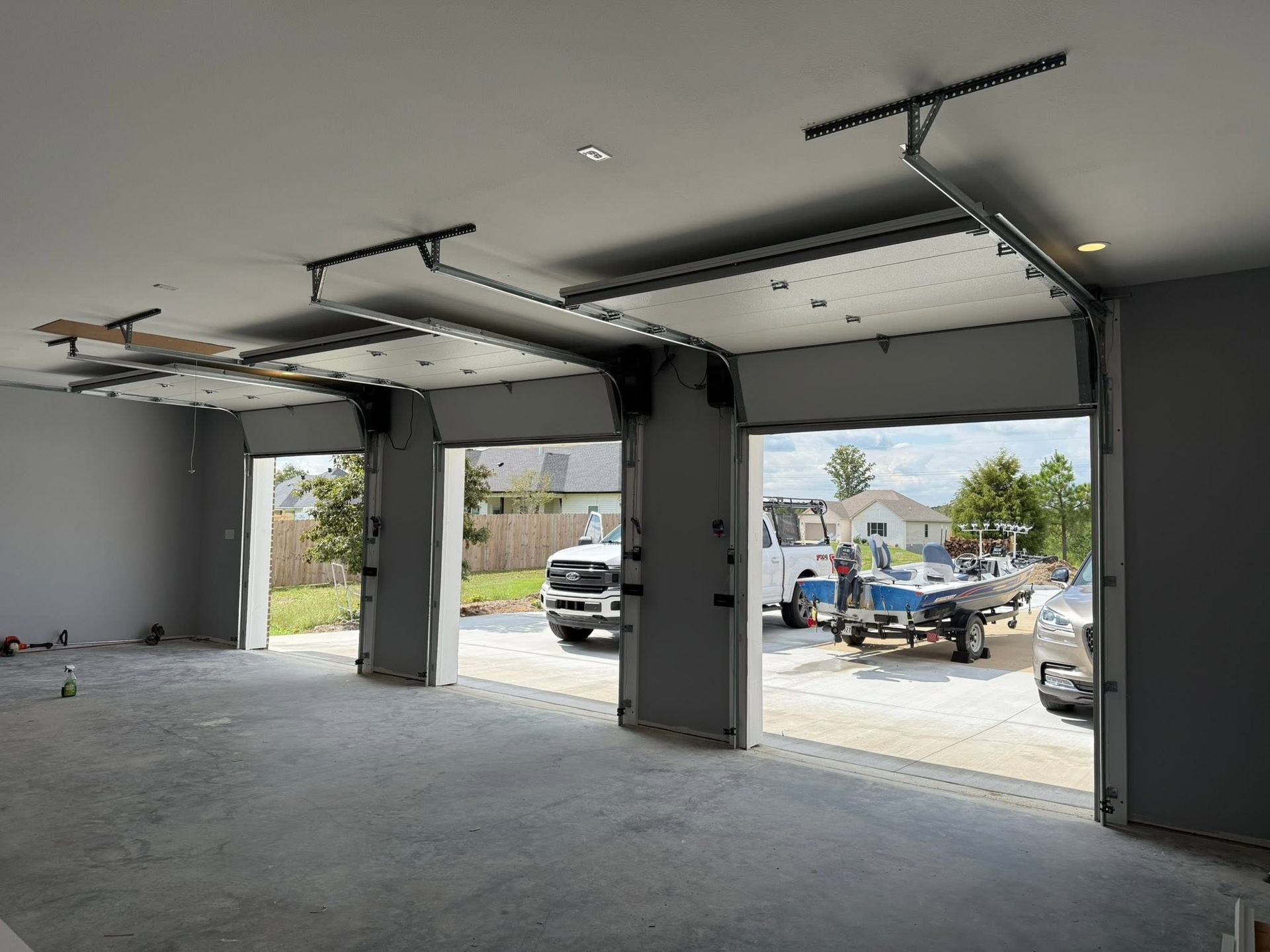
Worn Hardware on Older Doors Fails Without Warning
Garage Door Maintenance and Tune-Ups in Benton for doors running on aging components that have never been serviced
A significant portion of garage doors in Benton and the surrounding area have been running for a decade or more with no professional service. The wear that accumulates on those doors is not always visible from the outside—spring coils develop fatigue stress, cable strands begin to fray at the drum, and rollers lose their smooth bearing surface—but those conditions are exactly what most no-warning door failures trace back to. Fowler Overhead Doors, LLC performs tune-ups that walk the full door system and correct the small wear items before they sequence into an emergency call.
A tune-up covers spring tension and winding, cable condition and drum seating, roller wear and bearing surfaces, hinge lubrication, track alignment, and overall door balance. The technician also tests the opener's auto-reverse safety sensors and tightens hardware that has worked loose through repeated door cycles. Lubrication is applied with the correct product for each component—springs, hinges, and tracks each require a different formulation, and using the wrong lubricant on a track surface can actually attract debris and cause the rollers to drag rather than roll freely. At the end of the visit, the technician reports which components are in good condition and which will need attention before the next service interval.
Arrange a tune-up visit to get a current condition report on every component in your door system.
What Proper Garage Door Maintenance Requires
Effective maintenance on a sectional overhead door requires working through the system in a logical sequence rather than spot-checking individual parts. Spring tension is checked first because it affects how the door moves under manual operation, and a door that's out of balance will load the opener motor abnormally regardless of how well the opener itself is maintained. From there, the technician works through the cable and drum assembly, the rollers, the hinge pivot points, and finally the track and bracket hardware before running the door through a full automatic cycle to observe how all the components perform together.
After a completed tune-up, the door should open and close quietly, hold its position when stopped at mid-travel, and reverse cleanly when the auto-reverse sensor detects an obstruction. Hardware that was working loose tightens back to its correct torque, and properly lubricated hinges and rollers eliminate the grinding or squealing that signals metal-on-metal contact. Fowler Overhead Doors provides a condition report at the end of the visit so property owners know which components are performing correctly and which have a limited service life remaining.
Because Fowler Overhead Doors is owner-operated and handles repair work as a regular part of the business, the technician performing the tune-up is the same person who would respond to a failure on that door. That continuity means the condition notes from a maintenance visit carry forward into any repair work that follows rather than being lost between separate service providers.
Common Questions About the Work Itself
These questions address how the maintenance process works and what owners of doors in homes of varying ages should expect during a service visit.
What does checking spring tension actually involve during a tune-up?
The technician measures the door's balance by disconnecting the opener and lifting the door manually to mid-travel, then observing whether it holds position or drifts. A door that drops is under-sprung; one that rises is over-sprung. Spring winding adjustments are made in quarter-turn increments to bring the door to neutral balance.
How is cable condition assessed without disassembling the drum?
The cable is inspected visually along its full run from the bottom bracket to where it seats on the drum, with particular attention to the drum groove and the point where the cable bends around the bottom roller bracket. Fraying strands are visible at those wear points and indicate that replacement is due before the cable loses enough strands to fail under load.
Why does lubrication product choice matter for different components?
Hinges and roller stems accept a standard lithium-based grease that stays in place under load, while track surfaces should be wiped clean rather than lubricated because grease on a track surface collects debris that degrades roller movement. Springs are treated with a dry lubricant that reduces friction during winding without attracting dust.
How does the age of a home in Benton or Bryant affect what a tune-up finds?
Homes built in the 1990s and early 2000s in established subdivisions around Benton frequently have their original torsion spring systems, and those springs are typically rated for a finite number of cycles. A door that has been running daily for fifteen or more years may be approaching the end of the spring's rated life even if the coils look intact from the outside.
What does the auto-reverse sensor test involve and why does it matter?
The technician places a solid object—typically a two-by-four laid flat—in the door's path and triggers a close cycle to confirm the door reverses before contact. Auto-reverse systems are a required safety function, and sensors that have drifted out of alignment will fail this test even though the opener appears to operate normally otherwise.
Fowler Overhead Doors, LLC performs maintenance and tune-ups on both residential and commercial garage doors, and the same owner-operated crew handles any follow-up repair work identified during the visit. Fowler Overhead Doors also provides garage door maintenance in Bryant, Alexander, Bauxite, Haskell, and Shannon Hills. Call (501) 551-5220 to book a full system inspection.